
Permeate / treated water
Match it to the next use.
Test the treated water to see whether it suits the job you have in mind. It may need another treatment step first.
Reverse Osmosis
A reverse osmosis (RO) plant uses pressure to push water through a special filter called a membrane. It reduces dissolved salts for industrial water treatment and suitable reuse. The salt moves into a separate, concentrated flow that also needs a handling plan.
See how it works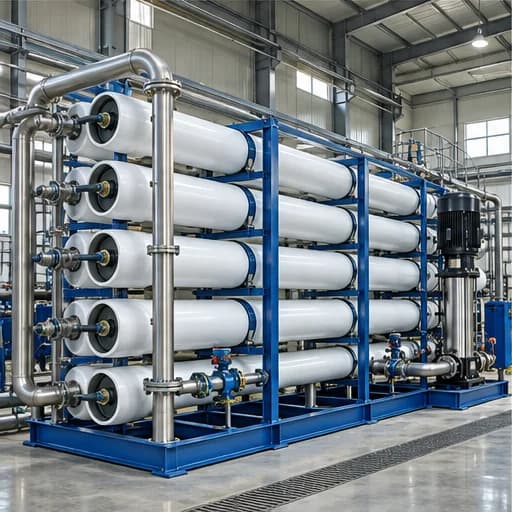
Where does the salt go?
A pump pushes water through the membrane. The water that passes through has less salt and is called permeate. The water left carrying more salt is called concentrate, or reject water. Both need a place to go.
Permeate / treated water
Test the treated water to see whether it suits the job you have in mind. It may need another treatment step first.
Concentrate / reject
The salt has moved into the leftover water. Decide how to treat or manage that saltier water before choosing the system.
The bigger picture
RO works best when the incoming water has been prepared for it. The filter also needs the right pressure and regular care.
Dirt can block the filter, and minerals can build up on it like deposits inside a kettle. Tests tell us what to remove or control before RO.
Explore Ultra filtration / Micro FiltrationIn some systems, heating the leftover water turns part of it into vapour. Cooling that vapour collects more water for possible reuse.
Explore evaporationBefore choosing a system
The type and amount of salt, the water temperature and other substances help us choose the filter and how to run it.
We need to know what the water will be used for. Looking clear does not tell us whether it is suitable.
Trying to recover more water makes the leftover water saltier. The design must avoid harmful deposits and provide a way to handle that water.
Let’s talk about cost
An RO system uses pressure to push water through membranes. Its cost includes the equipment, the power to run it and a plan for the salty water left over.
You pay for membranes, pressure vessels, pumps and controls. Treatment before RO protects the membranes, and storage or other equipment may also be needed.
The pumps need electricity. Membranes need cleaning and eventual replacement. Add water tests, maintenance, any treatment chemicals and the cost of handling the salty reject stream.
Saltier water can need more pressure or a different design. The amount of water you need and how clean it must be also affect the price. Recovering more water does not automatically mean a lower running bill.
A little clarity
Your water. Your requirements.
Tell us where your wastewater comes from, roughly how much you have each day and what you want to use it for. Share any water test results you have.
Based in Perundurai, Erode, Tamil Nadu. Serving Tamil Nadu, South India and India.