
Suitable incoming water
Test what is in the water and check how much arrives each day. The organisms must be able to live and work in it.
Membrane Bioreactor
A membrane bioreactor (MBR) combines biological wastewater treatment with filtration. Tiny living organisms break down suitable waste. A fine filter called a membrane then holds back the organisms and small solids while water passes through.
See how it works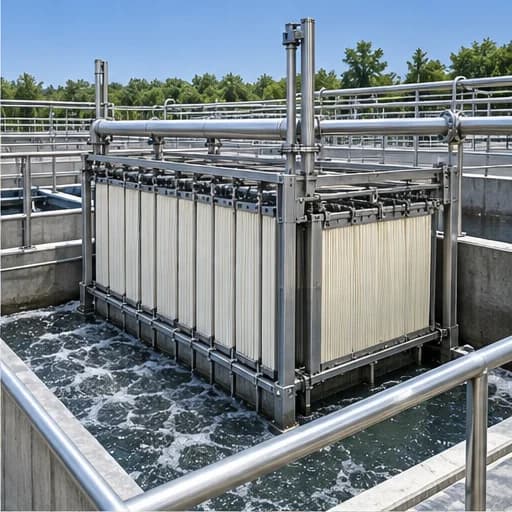
Two jobs, working together
Think of the membrane as a much finer version of a strainer. After the organisms have broken down the waste they can feed on, the membrane separates them from the water. This replaces the settling tank used for that job in many other systems.
The bigger picture
Both sewage plants and some factory wastewater plants can use MBR. It can do a job inside the plant, so you do not always need to add it after a complete ETP.
Remove larger bits of waste first. Check for chemicals that could harm the organisms or damage the filter.
The water may need another step to kill germs or remove dissolved salt before it can be used again.
Explore RO for dissolved saltsA smaller layout may help when space is limited. It still needs room for the amount of water being treated and for maintenance.
Explore Compact MBRBefore choosing a system
Test what is in the water and check how much arrives each day. The organisms must be able to live and work in it.
The filters need cleaning, regular checks and replacement when worn out.
Supply air, check the tank and remove excess sludge, the wet mixture of organisms and solids that builds up.
Let’s talk about cost
With MBR, you are paying for two jobs: a tank where microorganisms treat the water, and membranes that separate water from the solids. Membranes are fine barriers that also need care.
The starting price covers the treatment tanks, membranes, pumps, air-supply equipment and controls, along with the installation work included in the quote.
Electricity runs the pumps and air supply. You also pay for routine checks, cleaning, sludge removal and water tests. Membranes eventually need replacement, so allow for that future expense too.
The amount and condition of the incoming water affect the size of the system. The cleaning needs, spare equipment and required water quality also affect the total cost.
A little clarity
Your water. Your requirements.
Tell us where your wastewater comes from, roughly how much you have each day and what you want to use it for. Share any water test results you have.
Based in Perundurai, Erode, Tamil Nadu. Serving Tamil Nadu, South India and India.