How does the liquid behave?
Some liquids foam, leave hard deposits or attack metal. We check for these problems before choosing equipment.
Multiple Effect Evaporator
A multiple effect evaporator (MEE) recovers water from concentrated wastewater. Heating turns water into vapour, which supplies heat to the next stage. Cooling the vapour collects water while a smaller amount of more concentrated liquid remains.
See how it works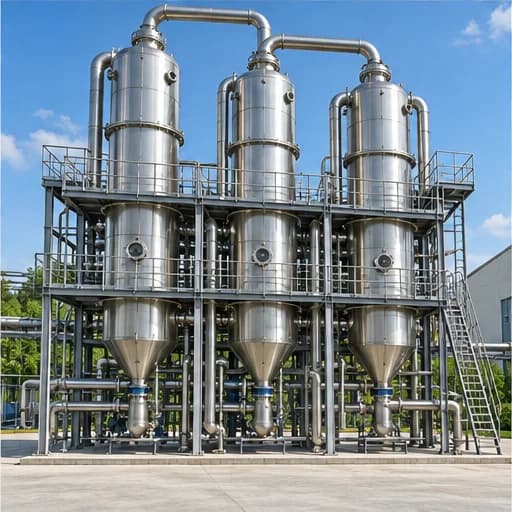
Why multiple effects?
Each boiling stage is called an effect. The next stage runs at a lower pressure, so water can boil at a lower temperature. That lets vapour from the earlier stage supply its heat, reducing the need for fresh steam.
The bigger picture
Two things leave the system: water collected by cooling the vapour, and liquid containing more of the leftover salts and waste.
Cool the vapour and it turns back into water, just as droplets form on a cool lid above a hot pan. This water is called condensate. Test it before reuse.
As water leaves, salts and other materials that do not evaporate become more concentrated. This leftover liquid may need more treatment or drying.
Understand thin film dryingBefore choosing a system
Some liquids foam, leave hard deposits or attack metal. We check for these problems before choosing equipment.
The system needs heat, cooling and electricity. What is available on site affects the design.
The stopping point depends on how the liquid changes as water leaves and how the remaining material will be handled.
Let’s talk about cost
An MEE uses heat to turn water into vapour, then uses that heat again in another stage. You pay for the equipment and for the energy and care it needs to keep running.
The starting cost includes the evaporation vessels, pumps, heat-transfer equipment and controls. Steam supply, cooling and site connections must be considered too.
Heat is a main running expense. Depending on the site, that may mean paying for steam or fuel. Electricity, cooling, cleaning and maintenance also belong in the budget.
Removing more water means a different workload. The liquid being treated, available heat supply and number of evaporation stages affect both the purchase price and the ongoing bills.
A little clarity
Your water. Your requirements.
Tell us where your wastewater comes from, roughly how much you have each day and what you want to use it for. Share any water test results you have.
Based in Perundurai, Erode, Tamil Nadu. Serving Tamil Nadu, South India and India.