
Can the organisms do their job?
Check whether the organisms can break down the waste and whether any chemicals could harm them or the filters.
Compact Membrane Bioreactor
A compact membrane bioreactor (MBR) combines organisms that break down waste with fine membrane filters. It brings the same MBR treatment process into a smaller layout for sites where space is limited.
Tiny living organisms use some of the waste as food. This breaks down waste that the organisms can feed on.
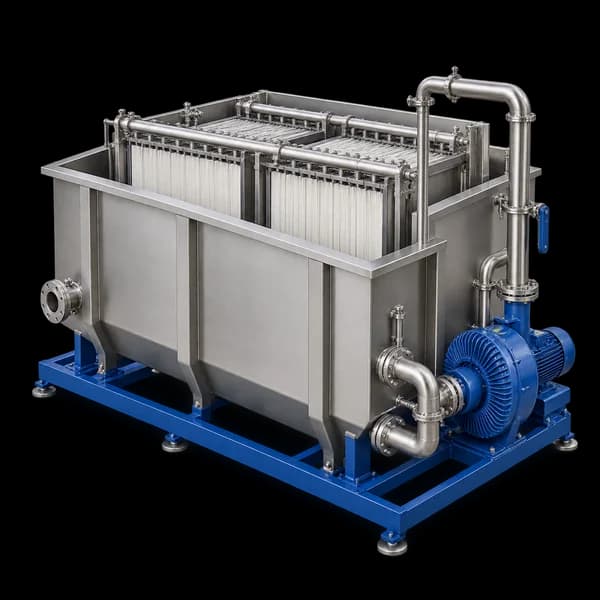
A filter called a membrane has tiny openings. Water passes through while the organisms and small solids stay behind.
A closer look
Think of a strainer that catches small pieces while water passes through. A membrane does a much finer version of that job. The organisms break down waste; the membrane separates them from the water afterwards.
Same idea, smaller layout
Many plants use a tank where solids settle out of the water. MBR uses a membrane for that job, which can save space.
You may still need space for screens, holding tanks, collected waste and extra treatment. The equipment shown is only part of the picture.
Leave space for people to check the equipment, wash the filters and take parts out for repair.
Compact MBR is MBR arranged in a smaller layout. Its size depends on how much water it must treat and what the site needs.
About MBR technologyA practical fit
A small site may benefit from a compact layout. We still need to check what is in the water and how clean it needs to be.
Check whether the organisms can break down the waste and whether any chemicals could harm them or the filters.
Count the space for earlier cleaning steps, tanks, power and water supplies, plus safe paths for people.
The plant needs air, regular checks and filter cleaning. Excess wet solids, called sludge, must also be removed.
Let’s talk about cost
Compact means arranged to use space carefully. It does not automatically mean a smaller bill. You still need the equipment and daily care that make the treatment work.
You pay for the biological treatment system, membranes, pumps and controls. Other tanks, site work and installation may be needed beyond the compact equipment shown in the illustration.
Electricity powers pumps and air supply. Regular checks, membrane cleaning, water tests and sludge removal cost money too. Include future membrane replacement in the budget.
A tight site can make installation or maintenance access harder. The amount of water, its condition and the space around the equipment matter as much as the size of the unit itself.
A little clarity
Your water. Your requirements.
Tell us where your wastewater comes from, roughly how much you have each day and what you want to use it for. Share any water test results you have, along with the space available on your site.
Based in Perundurai, Erode, Tamil Nadu. Serving Tamil Nadu, South India and India.